Plumbing Help for Elyria Homeowners and Renters
What household plumbing problems may mean, which ones should not wait, and what to do first when you rent.
Household plumbing rarely fails all at once. It starts with something small: a drain that takes a minute to empty, a toilet that refills by itself, a shower that turns lukewarm halfway through, a brown ring on the ceiling under a bathroom. Each sign has a short list of likely causes. Some can wait for a scheduled visit, and some cannot.
The work in a house covers drain cleaning and sewer line clearing, leak repair, water heater replacement, sump pumps, garbage disposals, and faucet and toilet repair, along with repiping older supply lines and fixture swaps during remodels. Most of our customers are homeowners and landlords, and the same problems turn up whether a house is owned or rented.
Knowing what a sign may mean helps you describe it on the phone and decide how fast to act. It does not replace a look at the pipes: a slow drain can be a clog or a blocked vent, and a stain can start well away from the spot where it shows.
Household Plumbing Problems and What They May Mean
Where a problem shows, and whether other fixtures have it too, narrows down the cause.
-
One sink or tub drains slowly
- What it may mean
- Hair, soap and grease building up in the trap or the first few feet of pipe. If the drain also gurgles, the vent may be blocked.
- Service page
- Drain Cleaning
-
Several drains are slow, or the basement floor drain backs up
- What it may mean
- A blockage in the main drain or the sewer line, past the point where the branch lines join. Run as little water as possible until it is cleared.
- Service page
- Drain Cleaning
-
Hot water runs out sooner than it used to
- What it may mean
- Sediment filling the bottom of the tank, a failed heating element or burner part, or a broken dip tube letting cold water mix into the hot.
- Service page
- Water Heaters
-
A stain spreading on a ceiling or wall
- What it may mean
- A leak at a supply fitting, a drain joint or a toilet seal above it. Water can run along a joist first, so the source may be in another room.
- Service page
- Pipe Repair
-
Weak pressure at every faucet
- What it may mean
- Older galvanized pipe narrowing with rust inside, or a main valve that is partly closed or failing. Weak pressure at one faucet is usually a clogged aerator.
- Service page
- Pipe Repair
-
A toilet runs or refills by itself
- What it may mean
- A worn flapper, or a fill valve set too high, so water keeps slipping from the tank into the bowl.
- Service page
- All Services
-
The sump pump runs nonstop, or the pit fills and the pump stays off
- What it may mean
- A stuck float switch, a failed check valve letting water fall back into the pit, or a pump that has worn out.
- Service page
- All Services
-
Water spraying from a pipe, or a pipe that froze and split
- What it may mean
- A burst pipe. Close the main shutoff before anything else.
- Service page
- Burst Pipes
When to Call a Plumber and When It Can Wait
Urgency comes down to two questions: is water going where it should not, and can you stop it? If closing a valve stops the problem, most repairs can wait for a scheduled visit. If water is spraying, close the main shutoff and treat it as a burst pipe before anything else.
Call Without Waiting
- Water is running, and the valve under or behind the fixture will not stop it.
- Water is coming through a ceiling, or reaching outlets, light fixtures or the electrical panel.
- Sewage or gray water is coming up through a floor drain, a tub or a shower.
- The water heater is leaking from the tank itself.
- The whole house has no water, or a faucet gives nothing during a hard freeze.
A smell of gas is different: leave the house and call the gas utility from outside.
Can Wait for a Scheduled Visit
- A faucet that drips, or a toilet that runs now and then.
- One drain that is slow but still empties.
- Low pressure at a single faucet, after you have rinsed its aerator.
- A drip under a sink that stops once the valve under it is closed.
- A fixture you want to replace, or a bathroom you plan to remodel.
Fixture Swaps During a Bathroom Remodel

A remodel is when a bathroom’s plumbing is easiest to reach. With the floor or a wall open, the supply lines, shutoff valves and drain connections behind each fixture can be checked and replaced instead of being closed in again for decades.
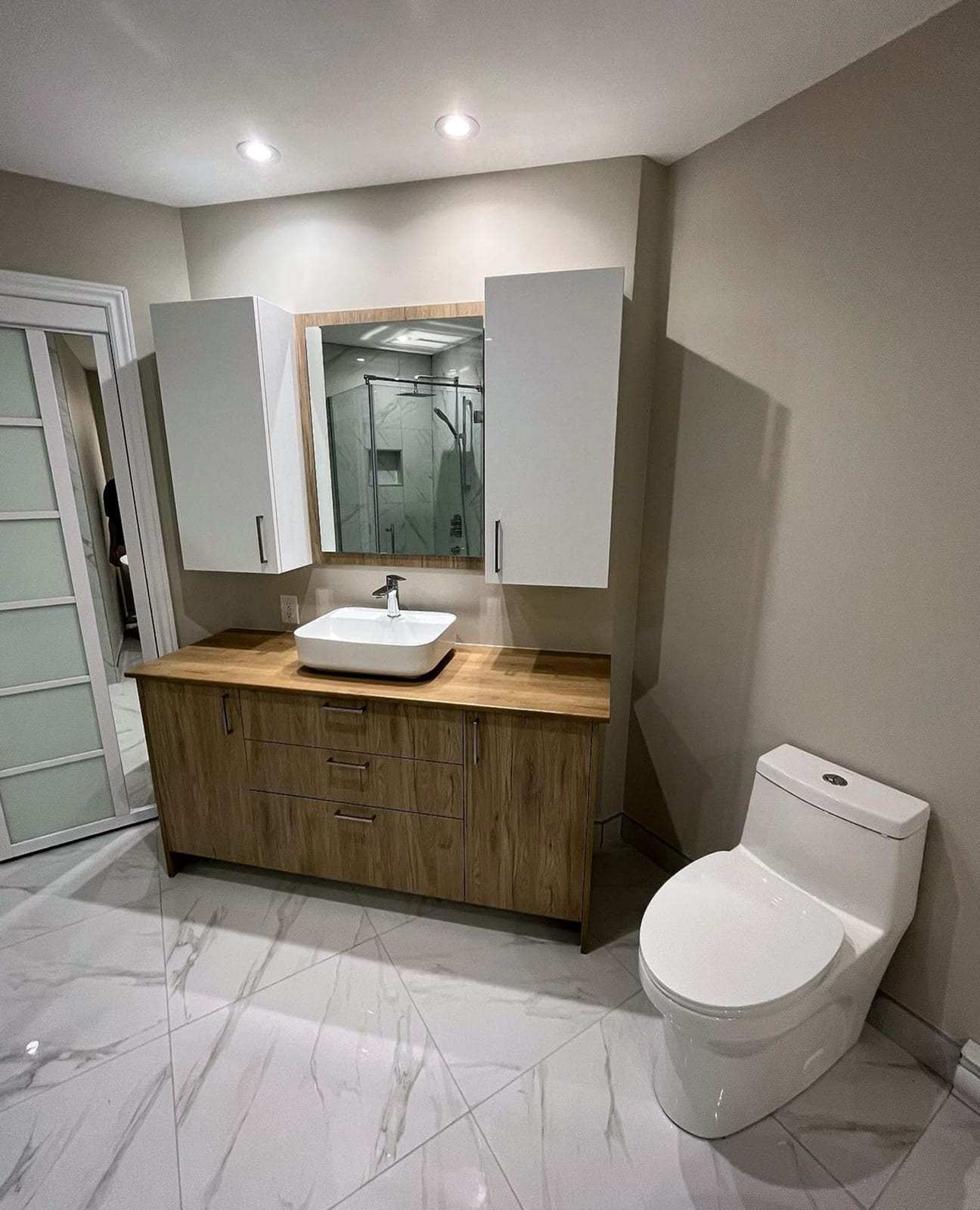
Each fixture asks for something different. A vessel sink sits higher and needs a taller faucet or a wall-mounted one. A freestanding tub needs its drain set under the floor exactly where the tub will stand, with supply lines brought up through the floor for its filler. A shower valve goes into the wall at the depth its trim calls for, before the tile.
Settle the fixture choices before the rough-in. Drains, valves and supply stubs are placed to each fixture’s own measurements, so a different tub or vanity later can mean moving pipe that is already in place.
If the house still has galvanized steel supply lines, a remodel is the natural time to replace the section behind the new fixtures. How copper and PEX compare with older pipe materials decides what goes in their place.
Repairs, Replacements and Getting Ready for a Visit
How can I get the house ready for a plumber’s visit?
Clear the space around the problem and the way to it. Empty the cabinet under the sink, move boxes away from the water heater and the main shutoff, and make room in front of any access panel behind a tub or shower. A plumber needs to reach the valves that control a fixture as well as the fixture itself.
Note when the problem started, which fixtures it affects, and whether it is constant or comes and goes. If the water heater is involved, a photo of its label helps, since it gives the model, the size and the fuel. Put pets in another room, and make sure someone can open the basement, the crawlspace or the garage.
Is a dripping faucet worth repairing, or is it time for a new one?
Most drips come from a worn cartridge, washer or O-ring, and those parts are made to be replaced. A faucet with a sound body and parts still on the market is usually worth repairing.
Replacement makes more sense when the body is cracked or corroded, the finish is flaking, the handles stay stiff after new parts go in, or parts for an older model are hard to find. A remodel is also a natural time to change a faucet, because the shutoff valves and supply lines under it can be replaced at the same time.
When does a toilet need replacing instead of a new part?
Most toilet trouble is in parts that wear out: the flapper, the fill valve, the flush handle and the wax ring under the base. Replacing those is a repair, not a new toilet.
A crack in the tank or the bowl is different. It cannot be fixed reliably, and it will leak. Replacement also makes sense for a toilet that clogs often because of a narrow trapway, or an older model that uses far more water per flush than current ones. If the floor around the base feels soft, water has been leaking for some time, and the subfloor needs a look before a new toilet goes in.
Should a garbage disposal that hums or leaks be repaired or replaced?
A hum with no grinding usually means a jam. With the switch off and the unit unplugged or its breaker off, a hex key in the socket on the bottom turns the grinding plate back and forth until the jam breaks loose, and the reset button on the bottom restarts the motor. Never reach inside the unit.
Leaks decide it differently. A leak at the sink flange or at the drain connection is a repair. A leak from the body of the disposal means the grinding chamber has corroded through, and the unit needs replacing. So does a motor that still hums without turning after the jam has been cleared.
Know Where the Water Turns Off Before a Leak Starts
Every house has a main shutoff where the water line comes in, usually on the basement wall nearest the street, beside the water meter. Most fixtures have their own as well: two small valves under each sink, one behind each toilet, and one on the cold line above the water heater.
In many older Elyria houses the main shutoff is still a gate valve with a round handle that takes several turns. After years without use it can stick, break inside when forced, or never close all the way, which is a bad thing to discover with water on the floor. A main valve with a lever handle closes in a quarter turn and shows at a glance whether it is open.
Find each valve now, while nothing is leaking, and tag the main one. Close and reopen each valve once or twice a year so it keeps moving; one that will not turn, or will not stop the water, is worth replacing before you need it. That check fits into the same seasonal care routine as disconnecting garden hoses in the fall.
Renting a House: Report Leaks and Clogs to the Landlord
If you rent, tell the landlord or property manager before calling a plumber. In most rentals the owner arranges plumbing repairs, and the lease usually says how to report a problem and who to call in an emergency.
Report it in writing as well as by phone: a text or an email with a photo, the fixture involved and the day it started. Small leaks grow, and a dated message shows when the problem was first reported.
While you wait, close the valve under the fixture, or the main shutoff if water is running, keep water away from outlets and cords, and stop using a drain that backs up. If the landlord asks you to book the visit yourself, agree first on who pays for it.
Owners and landlords can book a repair through Schedule Service.