
Water Heater Repair and Replacement in Elyria, OH
Gas and electric tank heaters and tankless units: repairs, replacement and choosing the right size.
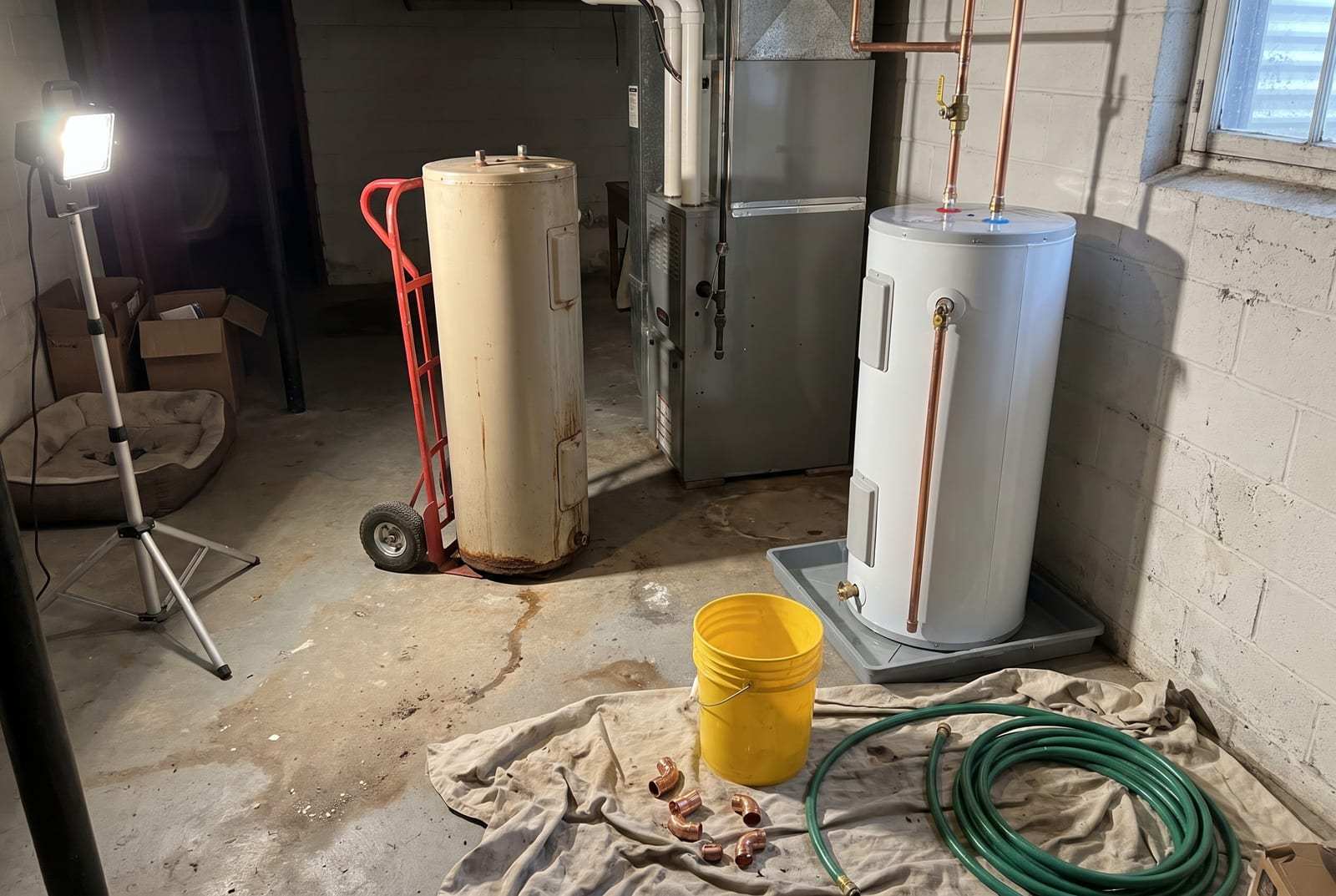
A water heater usually warns before it fails: hot water that runs out sooner, rumbling from the tank, rusty hot water, or a drip at a valve. Some of these are repairs; others mean the tank is near the end of its life.
Tanks wear out from the inside. Sediment settles at the bottom, the anode rod that protects the steel gets used up, and once the tank rusts through, nothing is left to repair. Many tanks last around 8–12 years, depending on the water and the upkeep.
A replacement means choosing the type and size, then connecting the new heater with venting, gas or wiring, and relief valve piping that meet current code.
Choosing a Water Heater Size
Too small, and the hot water runs out partway through a shower; too large, and you pay to keep extra water hot all day. For a tank, the household sets the size. For a tankless unit, the number of hot-water uses at once sets the flow it has to deliver.
Water Heater Sizing Guide
A use is one shower, a tub filling, the dishwasher or the washing machine on hot.
Set your household’s answers, then press “Suggest a Size”.
On a tank, the first-hour rating on the yellow energy label shows how much hot water it delivers in a busy hour, which says more than the gallons alone.
Tank, Tankless and Heat Pump Water Heaters Compared
| Type | How It Works | Works Well For | Things to Consider |
|---|---|---|---|
| Tank, gas | A burner under the tank heats 30–75 gallons of stored water. | Houses with a gas line and a sound vent or chimney. | Needs combustion air and a working vent. Reheats faster than electric, so it can be a size smaller. |
| Tank, electric | Two elements, each with its own thermostat, heat the stored water. | Houses without gas, or a spot where no vent can run. | Reheats more slowly than gas. Needs a 240-volt circuit, but no vent. |
| Tankless, gas | A burner fires only while hot water runs, heating it in a heat exchanger. | Households that run out of hot water from a tank. | Flow is limited, most of all with cold winter water. Often needs a larger gas line, its own vent and descaling. |
| Tankless, electric | Elements heat the water on demand, with no tank and no vent. | One fixture far from the main heater, or a small apartment. | A whole-house unit draws more current than many older electrical services can supply. |
| Heat pump | A heat pump moves warmth from the room air into a storage tank, with elements as a backup. | Houses replacing an electric tank, with a roomy basement or utility room. | Taller than a standard tank. Needs a condensate drain and space around it, and cools the room. |
Tankless output depends on how much the water has to be warmed. Winter water in northeast Ohio often comes in around 40–50°F, so compare tankless models by their flow at a 70–80°F rise, not by their largest rated flow.
Water Heater Parts That Fail Before the Tank Does
These parts can fail on a sound tank, and replacing one can give it more years:
- Elements and thermostats (electric): a failed upper element leaves no hot water; a failed lower one leaves a little that runs out fast.
- Thermocouple or flame sensor (gas): a pilot that will not stay lit often comes back to this small part.
- Dip tube: the pipe that carries cold water to the bottom of the tank. If it breaks, cold water mixes in at the top and the hot water runs out fast; bits of white plastic in faucet screens are a clue.
- Anode rod: a rod that corrodes so the tank does not. A rotten-egg smell from the hot water alone can come from the rod, and a different type of rod can cure it.
- Relief and drain valves: a dripping relief valve may be worn or reacting to high pressure in the house; a plastic drain valve can drip after years of sediment.
A leak from the tank body itself is not a repair. The steel has rusted through, and the heater needs replacing.
Signs a Tank Water Heater Is Failing
- Hot water runs out sooner than it used to.
- Rumbling or popping as the tank heats.
- Rusty water from the hot taps only.
- Rust or moisture on the tank or around the fittings on top.
- Water in the drain pan or on the floor around the base.
- A tank past ten years old, by the date coded in its serial number.
One sign alone may be a repair. Several together usually mean the tank is near the end, and replacing it before it leaks is easier than after. If two or more of these sound familiar, call (440) 581-1393.
Water Heater Repairs, Flushing and Gas Safety
Should I repair my water heater or replace it?
Repair makes sense when one part has failed on a tank that is still sound: an element, a thermostat, a thermocouple, the dip tube or a valve. Replacement makes sense when the tank itself leaks, when the hot water comes out rusty, or when the heater is near the end of the usual 8–12 years and the repairs are adding up.
The age is coded in the serial number on the label, usually in its first few characters.
Why is there no hot water at all?
On a gas tank, look through the small window near the bottom to see whether the pilot is lit. A pilot that will not stay lit points to the thermocouple, the flame sensor or the gas supply.
On an electric tank, check the breaker first. Past that, the high-limit switch, elements and thermostats sit behind covers on live 240-volt wiring, so they are a job for a plumber. A tankless unit usually shows an error code.
What does flushing a water heater do?
Minerals settle at the bottom of a tank as sediment. Flushing runs water out through the drain valve to carry it away, which quiets the rumbling and helps the heater recover faster.
A tank that has gone years without a flush is a different case: hardened sediment can clog the drain valve, and an old plastic valve may not close tightly again. On a tankless unit, the same job is a descaling of the heat exchanger.
How can I tell if a gas water heater is venting safely?
These are warning signs on a gas water heater:
- Soot or scorch marks around the draft hood on top
- Melted plastic on the fittings at the top of the tank
- A yellow, lazy flame instead of a steady blue one
- A carbon monoxide alarm sounding
Any of these is a reason to turn the heater off and have the venting checked. If a carbon monoxide alarm sounds, get everyone outside and call 911. If you smell gas, leave the house and call the gas utility from outside.
Replacing a Water Heater: Venting, Relief Valve and Expansion Tank

A new heater is more than a tank set where the old one stood. A gas model needs a vent sized for it, combustion air, a gas shutoff and a sediment trap on the gas line; an electric model needs a circuit matched to its elements.
Every tank needs a temperature and pressure relief valve, with a discharge pipe ending just above the floor or at a drain. Where a check valve or a pressure-reducing valve closes off the system, an expansion tank absorbs the water’s expansion as it heats.
Venting needs the most care. A gas water heater left alone in an old chimney, after the furnace is replaced with a model that vents out a side wall, may not draft properly; the chimney then needs a liner, or the heater a new vent route.
Several of these steps can call for a permit and an inspection, depending on the local building department.