
Pipe Repair and Repiping in Elyria, OH
Leaking, corroded and frozen supply lines repaired, from a single fitting to a whole-house repipe.
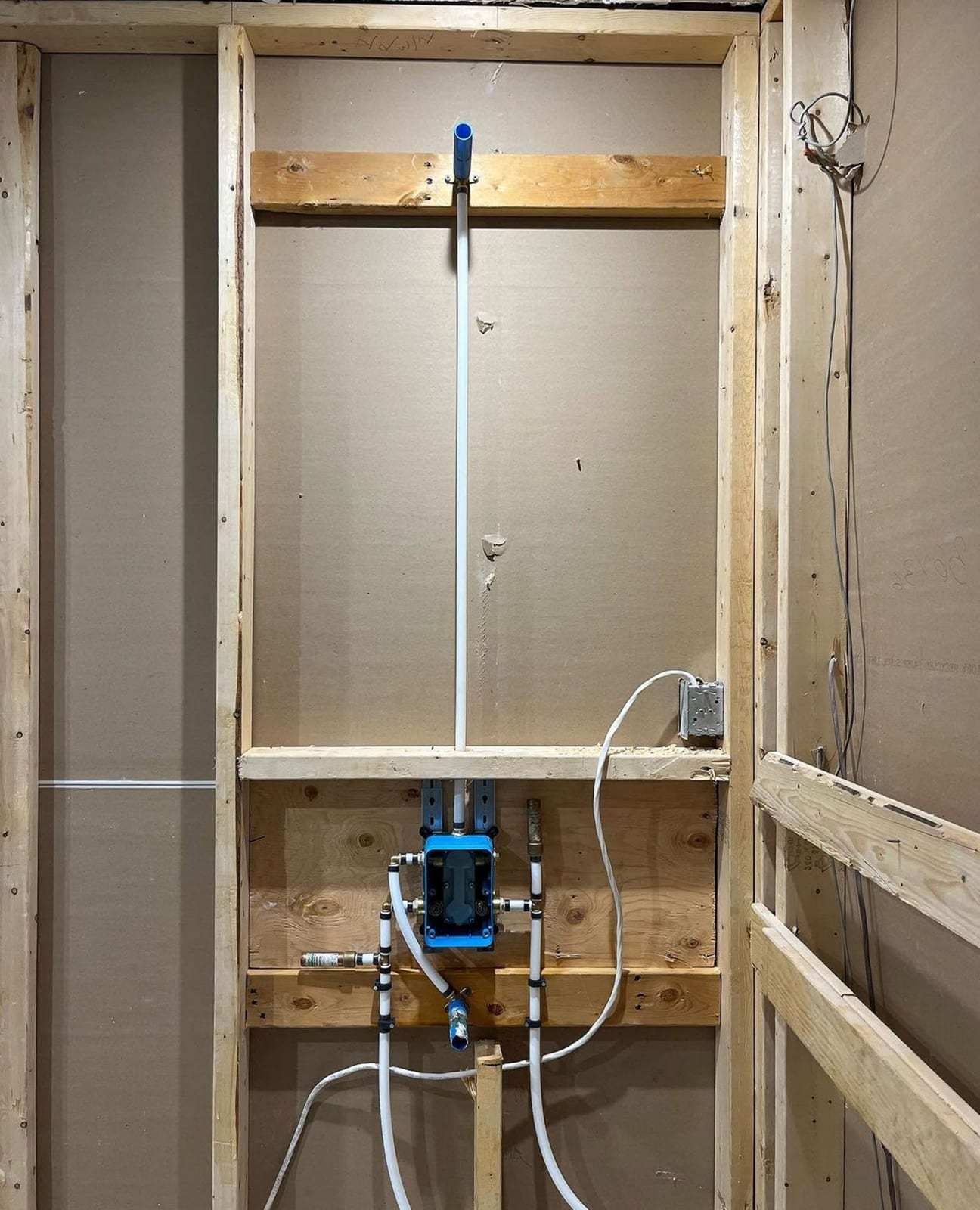
Supply pipes carry water under pressure from the main shutoff to every faucet, toilet and appliance, and to the water heater. Because they are always under pressure, a small flaw becomes a leak, and a leak inside a wall or ceiling can run for weeks before it shows.
Pipe repair comes in three sizes. A spot repair fixes one leak in pipe that is otherwise sound: a pinhole, a cracked fitting, a worn valve. A section replacement swaps out a run of damaged or corroded pipe. A repipe replaces the supply lines through the whole house, or through one part of it.
A remodel is the easiest time to repipe. With the walls open, older supply lines can be replaced and new lines run to the shower valve, tub, vanity and toilet before the walls close again, so the new fixtures are not connected to old pipe.
Supply Pipe Problems and the Usual Repair
The right repair depends on the pipe material, its age and its history. A pipe spraying water comes first: close the main shutoff and follow the steps for a burst pipe.
-
Pinhole leak in copper
- Typical signs
- A fine spray or a slow drip, often with a green or blue stain at the spot
- Usual approach
- Spot repair with a coupling or a short new piece; repeated pinholes in one run mean that run is replaced
-
Leaking joint, valve or fitting
- Typical signs
- Drips at a soldered joint, a crusty buildup, or water at a valve stem
- Usual approach
- Spot repair: a new fitting, a remade joint or a new valve
-
Corroded galvanized steel lines
- Typical signs
- Weak flow at several fixtures, rusty water after the taps sit unused, leaks at threaded joints
- Usual approach
- Section replacement where it leaks, with a repipe planned for the rest of the line, which is just as old
-
Pipe split by freezing
- Typical signs
- No water at a fixture during a lake-effect cold snap, then a leak as the pipe thaws
- Usual approach
- Section replacement, plus insulation or a new route away from the cold wall or crawl space
Tracing a Leak That Shows Up Somewhere Else
Water travels before it shows, along joists and pipes, so a stain is rarely right under its source. A ceiling stain that starts in another room is a common example: the stain is in the hallway, and the leak is at a shower valve or a toilet supply line around the corner.
A supply line leaks constantly, since it is always under pressure, while a drain or a fixture seal leaks only when that fixture runs. Running fixtures one at a time separates the two, so the ceiling can be opened in the smallest spot that reaches the source.
Low pressure can hide its cause the same way: weak flow at a kitchen faucet may be low pressure traced to a corroded pipe in the basement.
Signs of a Hidden Leak, and a Water Meter Test
- The water bill rises with no change in how much water the house uses.
- You hear running water when every fixture is off.
- A musty smell, peeling paint or soft drywall on a wall with plumbing in it.
- A stain on a ceiling under a bathroom or kitchen, even a faint one.
- Warped flooring or loose tiles near a tub, toilet or dishwasher.
The water meter can confirm a leak in a few minutes:
- Turn off every faucet and appliance that uses water, including the ice maker.
- Find the meter, often in the basement where the main line comes in, and its leak indicator: a small triangle or dial that turns with any flow.
- Watch it for a few minutes, or note the reading and check again after an hour with no water used.
- If it moves, close the main shutoff. If the meter then stops, the leak is inside the house; if it keeps moving, the leak may be in the line from the meter to the house, or the shutoff is not closing fully.
A toilet is a common hidden leak. Put a few drops of food coloring in the tank and wait without flushing; color in the bowl means the flapper is leaking.
Repiping Older Supply Lines and Remodels

A repipe makes sense when the pipe itself is the problem rather than one spot in it: galvanized lines narrowed by rust, copper with repeated pinholes, or plastic lines with failing fittings.
New lines usually run through the basement joists and interior walls by the shortest practical route, with small openings at each fixture rather than whole walls taken down. The old pipe is disconnected, and the water is off while the new lines are tied in.
In a remodel, the room being opened is repiped from its shutoff to each fixture before tile or drywall goes back, and the fixtures are swapped at the same time: a new shower valve, tub filler, vanity faucet or toilet goes onto new supply lines instead of decades-old ones.
Copper, PEX and CPVC each have strengths for a repipe, compared side by side under pipe materials.
Spot Repairs, Weak Pressure and Rusty Water
When does repiping make more sense than fixing one leak?
A spot repair suits a single leak in pipe that is otherwise sound. Repiping makes more sense when:
- The same run of pipe has leaked more than once
- Galvanized pipe is already affecting the pressure or the water color
- Leaks keep turning up at the same kind of fitting
- The walls are open for a remodel anyway
A partial repipe, one bathroom or one branch at a time, is also possible.
Why is the water pressure low at some faucets but not others?
Low pressure at one faucet is usually the faucet itself: a clogged aerator or a worn cartridge, so unscrew and rinse the aerator first.
Low pressure at several fixtures points further back: a shutoff valve that is not fully open, a failing pressure-reducing valve near the meter, or old galvanized pipe narrowed by rust. If the neighbors are low too, call the city water department.
What does brown or rusty tap water mean?
Rusty water from the hot taps only usually comes from the water heater. Rust in hot and cold, worst after the taps sit unused, points to corroding galvanized pipe in the house. A sudden change at every tap, often next door too, usually follows work on a city water main or hydrant flushing, and it clears after the cold water runs for a few minutes.
Black specks often come from a rubber washer or hose breaking down.
How do galvanized steel and other older supply lines fail?
Galvanized steel rusts from the inside. The rust narrows the pipe until the flow drops, colors the water, and finally eats through at the threaded joints, where the pipe wall is thinnest.
Gray polybutylene plastic, put in from the late 1970s into the 1990s, tends to fail at its fittings without warning, and older thin-wall copper can develop pinholes. With all three, one failure is usually followed by more.
Shutoff Valves and Supply Lines Under Fixtures
Many leaks start in the last few feet of pipe: the shutoff valve under a sink or toilet and the flexible line from it to the fixture. Old multi-turn valves drip at the stem or will not close fully, and quarter-turn valves are the usual replacement. Supply hoses that bulge, kink or rust at their ends are worth replacing before they burst.
If a fixture valve drips, a bucket and a towel buy time, but forcing a stiff valve can turn a drip into a spray. For a leak you can see, or one you only suspect, call (440) 581-1393.