
Pipe Materials Compared: Copper, PEX, CPVC and More
Where each supply and drain material is used, how it ages and copes with a freeze, and what tends to be behind the walls of an older house.
A house’s plumbing is two systems, usually in different materials. Supply lines bring water in under pressure, so they need pipe that holds pressure and is safe for drinking water. Drain lines carry waste out by gravity, so they need a smooth inside and enough size to keep everything moving.
Most houses have a mix. A house built with galvanized steel supply lines and a cast-iron drain stack often has copper or PEX added in a remodel, and a section of PVC where a drain was replaced. Each material fails in its own way, and knowing which ones are in the house helps explain a leak, a stain or a drop in pressure.
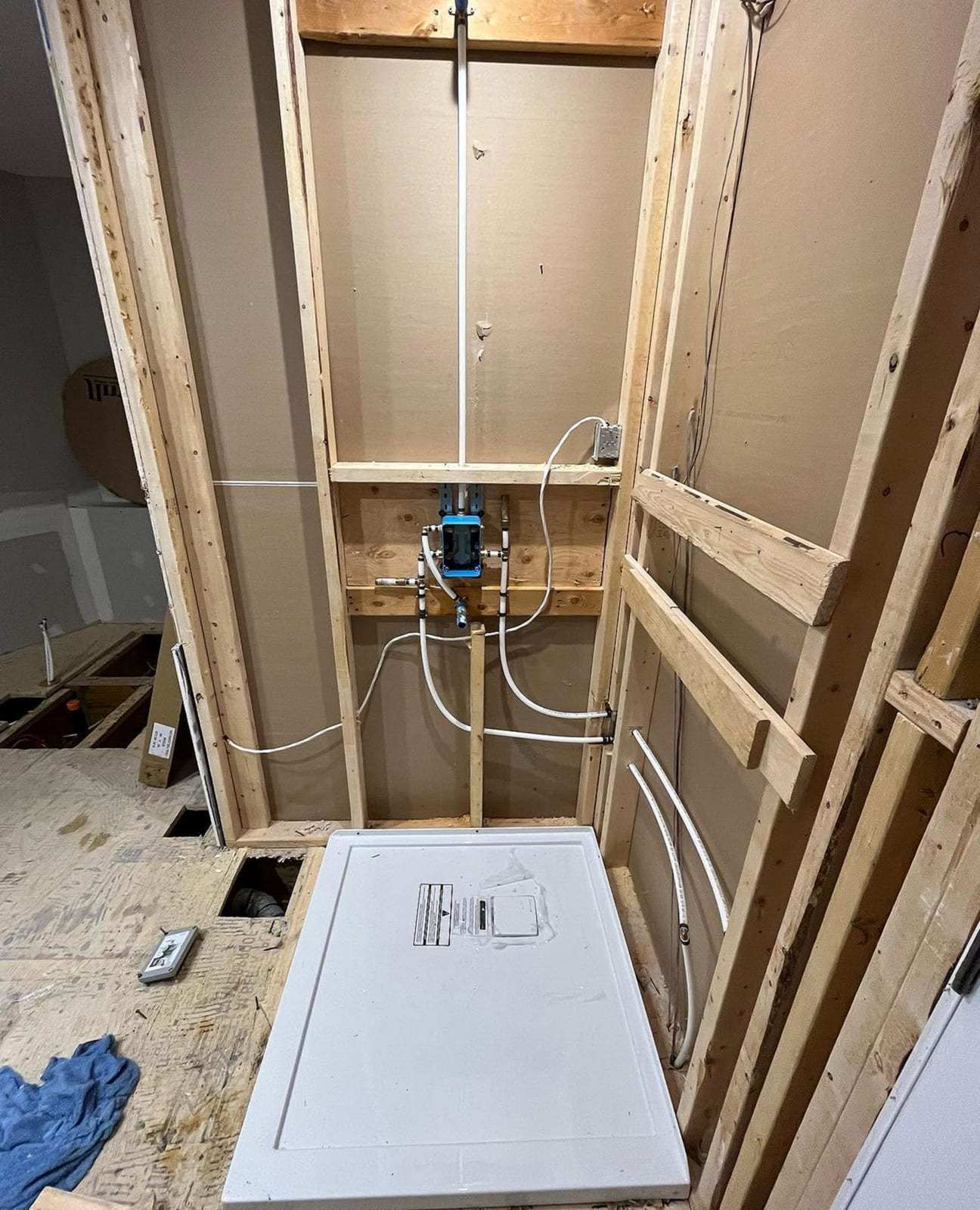
PEX, the flexible plastic tubing in red, blue or white, now goes into many remodels. It bends around framing with fewer fittings and copes with freezing better than rigid pipe. Copper is still common where pipe runs exposed and at the connections to the water heater.
Supply and Drain Pipe Materials Side by Side
Copper, PEX and CPVC carry water in. PVC, ABS and cast iron carry it out. Galvanized steel turns up on both sides in older houses.
| Material | Supply or Drain | Strengths | Limits | Behavior in Freezing Weather | Often Found in Homes Built |
|---|---|---|---|---|---|
| Copper | Supply (some older drains too) | Long-lived; handles heat; solid soldered or pressed joints | Pinhole leaks as water wears it from inside; more fittings than PEX | Rigid: ice can split it or open a joint | About the 1950s into the 2000s |
| PEX | Supply, hot and cold | Flexible; long runs with few fittings; resists scale and corrosion | Breaks down in sunlight; kept clear of heater flues; mice can chew it | Stretches as ice forms, so it splits less often | The 2000s on; common in remodels and repipes |
| CPVC | Supply, including hot water lines | Does not corrode; glued joints, no torch | Turns brittle with age; old lines crack when moved | Rigid: can crack when water freezes in it | Mostly the 1980s on |
| Galvanized steel | Supply; some old drains and vents | Strong and hard to puncture | Rusts inside, narrowing the pipe and staining the water | Can split, often at the threaded joints | Before about 1960 |
| PVC | Drain, waste and vent (white) | Light, smooth inside, does not rust | Not for hot supply water; louder than cast iron | Traps and lines in cold spaces can freeze | The 1970s on |
| ABS | Drain, waste and vent (black) | Tough; one-step cement; takes cold well | Needs a transition fitting to meet PVC; warps in high heat | Stays tough in the cold, though traps can still freeze | Mostly the 1970s and 1980s |
| Cast iron | Drain, waste and vent, including the main stack | Quiet, heavy, very long-lived | Rusts inside; cracks along the bottom of level runs | Rarely freezes inside a heated house | Before about 1970; many older stacks |
The eras are rough. A house is rarely one era throughout: repairs and remodels leave newer pipe beside the original, sometimes joined with the wrong fitting. Whatever the material, pipe and fittings that carry drinking water must be approved for it and lead-free, and the local building department decides when a repiping job needs a permit and an inspection.
How Each Pipe Material Shows Its Age

Every material ages in its own way, and the signs often show what is happening inside a wall before it is opened.
Galvanized steel rusts from the inside. The opening narrows until the upper floors get a trickle, and water that has sat overnight runs brown for a few seconds. Leaks start at the threaded joints, where the pipe wall is thinnest.
Copper lasts for decades, but not forever. Green crust at a joint means a slow seep. Pinhole leaks can follow when the water wears the pipe from the inside, and one pinhole often means more along the same run.
Cast-iron drains rust from the inside too, and the bottom of a level run wears thinnest. A rust line or a damp streak along the underside, or a sewer smell in the basement, can point to a crack.
- CPVC turns yellow and brittle with age. If one pipe cracks when it is moved for a repair, the rest is likely just as brittle.
- Polybutylene, a gray plastic supply pipe found in some houses from about the late 1970s to the mid-1990s, tends to fail at its fittings and is replaced rather than repaired.
- PEX problems usually start at a fitting that was not crimped or pressed fully, or in a stretch left in sunlight or chewed by mice.
- PVC and ABS drains last a long time. Trouble starts at a joint that was not glued fully, or a pipe left without enough support.
One sign in one spot usually calls for a local repair. The same sign in several places, or a second leak on the same run, is when replacing a whole section or repiping starts to make sense.
Replacing and Mixing Pipe in an Older House
What replaces old galvanized, cast-iron or polybutylene pipe?
Galvanized steel supply lines are usually replaced with copper or PEX, and so is polybutylene. Cast-iron drains are replaced with PVC, joined to the cast iron that stays with shielded couplings: a rubber sleeve under a stainless steel band.
The pipe that brings water in from the street deserves a look too. If it is dull gray, soft enough to scratch to a shine with a key, and a magnet does not stick to it, it may be lead. Ask the city water department about the service line before the house is repiped.
Can different pipe materials be joined in one system?
Yes, with the right transition fitting. Most older houses already mix materials after years of repairs, and what matters is the joint between them.
- Copper to galvanized steel: a dielectric union or a brass fitting, because the two metals in direct contact corrode faster.
- PEX to copper: a crimp, clamp, press or push-fit adapter made for both.
- PVC to cast iron: a shielded coupling.
- PVC to ABS: a mechanical coupling, or a transition cement where the local code allows it.
Plastic pipe cements are not interchangeable either. PVC, CPVC and ABS each have their own, and a joint made with the wrong one can fail years later.
Which pipe material suits an older house?
For supply lines, PEX is often the practical choice in a house with plaster walls. It can be fished through walls and floors with fewer openings, and it copes with a freeze better than rigid pipe. Copper suits exposed runs along the basement joists and the connections near the water heater. For drains, sound cast iron can stay, since it is quieter than plastic, with PVC replacing the sections that have failed.
Check one thing before metal pipe comes out. In many older houses the electrical system is grounded or bonded through the metal water pipe, and replacing it with plastic can break that path. Have an electrician confirm the grounding after a repipe.
Choosing a Pipe Material: Questions to Ask
A few questions narrow the choice for a repair or a remodel:
- Is the line for water supply under pressure, or for drains?
- Will it run through a cold space, such as an outside wall, a crawlspace or a garage ceiling?
- Will it sit in sunlight or near a water heater flue, where plastic breaks down?
- What will it join, and which transition fitting connects the two materials?
- How much old pipe is left beyond the repair, and is more of it worth replacing while the wall is open?
- Will the pipe stay within reach, or be closed in behind tile and drywall?
- Does it pass a bedroom or a living room, where water running through a plastic drain can be heard?
Which pipe suits a particular house is easiest to judge on site: call (440) 581-1393.